
Criminal Court Records in Benzie County
A criminal court record is the case file a court opens once formal charges are filed against a person. It gathers the charges, the pleas, every motion and hearing, and the final judgment in one running record. In Benzie County these files are kept by the court clerk for the court that hears the case. The record grows as the case moves, so an open file looks different from a closed one. Each entry is dated, which lets a reader follow the case in order.
Two trial courts handle criminal matters in the county. The 85th District Court hears misdemeanors, arraignments, and preliminary matters, while the 19th Judicial Circuit Court hears felonies and cases bound over for trial. The circuit is shared with Manistee County, yet Benzie cases carry their own numbers. Most felonies begin in the district court for a first appearance, then move up to the circuit court once the case is bound over. The county prosecutor decides what to charge and files the case. The image below comes from the Benzie County Prosecutor page.
That office reviews police reports and turns an arrest into the charges that open a criminal court record.
How to Search Benzie County Criminal Court Records
The main public path is MiCOURT, the statewide case search run by the Michigan courts. It covers circuit, district, and probate cases where the record is public. The county clerk and circuit court pages both point searchers to the same system, filtered to the local court.
- Open the MiCOURT case search and choose the case search tool.
- Search by the defendant's first and last name, or enter a case number if you have one.
- Narrow the results by court, case type category, and filing date to split criminal matters from civil ones.
- Open the case to read the charges, the docket events, and the disposition once it is entered.
- Request a certified copy from the Benzie County Clerk when you need a record that counts in court.
Name searches match the start of a name, so enter it as cleanly as possible. Benzie court results are reached through the local 19th Circuit court filter. A traffic matter that turned criminal may also surface through the state ticket portal rather than the main case search.
Stages of a Benzie County Criminal Case
A criminal case moves through set stages, and each one leaves a mark in the record. The file starts when charges are filed and ends at sentencing or dismissal. Reading the docket in order shows where a case stands and what comes next.
Case flow: Charges Filed › Arraignment › Pretrial / Motions › Plea or Trial › Disposition › Sentencing
| Stage | What Happens |
|---|---|
| Arraignment | The defendant hears the charges, enters a first plea, and the court sets bond and release terms. |
| Pretrial / Motions | Lawyers trade evidence and file motions, and the court settles issues before any trial. |
| Plea or Trial | Most cases end in a plea; others go to a jury or bench trial where guilt is decided. |
| Sentencing | After a plea or guilty verdict, the judge orders jail, probation, fines, costs, or a mix. |
The elected prosecutor carries the case for the people at every stage. The photo below is from the Benzie County Prosecutor bio page.
Sara Swanson leads that office, and her staff show up in the record as the party filing and arguing the charges.
What a Benzie County Criminal Court Record Shows
A criminal court record is built from a set of standard fields. The public case search surfaces the core ones, while the full file adds motions, orders, and event notes. The table below lists the fields a reader relies on most.
| Field | What It Shows |
|---|---|
| Case Number | The unique file number the court assigns; the fastest key to pull the record. |
| Defendant | The person charged, listed with the court and the assigned judge. |
| Charges | Each count with its statute cite and severity, from misdemeanor to felony. |
| Plea | How the defendant answered each charge, such as guilty, not guilty, or no contest. |
| Disposition | The outcome of each charge, such as convicted, dismissed, or acquitted. |
| Sentence | What the court ordered after conviction, including jail, probation, fines, and costs. |
The docket also lists the filing date, the next hearing, and every event in between. A closer look at the counts themselves, including how each is worded and coded, sits with Benzie County arrest records and court charges.
Charges vs. Convictions
Being charged is not the same as being convicted. A criminal court record can show counts that were dropped, dismissed, or that ended in acquittal. A charge is only an accusation, and it stays on the record even when the case ends without a conviction. Reading the disposition matters as much as reading the charge.
| Charge | Conviction | |
|---|---|---|
| Stage | Accusation | Verdict or plea |
| Burden of Proof | Probable cause | Beyond reasonable doubt |
| Public Record | Yes | Yes |
The distinction matters for anyone reading a file for the first time. A dropped or dismissed count still appears in the docket history, even though it never led to a penalty. A conviction, by contrast, carries a sentence and can follow a person into later background checks. For records beyond criminal matters, the county's Benzie County court records cover civil, family, and probate files too.
Reading Dispositions and Sentences
The disposition tells you how each charge ended. Common entries include guilty, not guilty, dismissed, nolo contendere, and deferred. A deferred outcome holds judgment while the defendant meets set conditions, and the charge may drop off if those terms are met. The sentence follows a conviction and lists the penalty in plain terms. It may combine jail time, probation, fines, court costs, and restitution to a victim.
Victims have a voice at sentencing, and the prosecutor's office runs a victim advocate program to support them. The image below is from the Benzie County victim advocate page.
Joni Pataky serves as the office's victim advocate, and victim input can appear in the record before a sentence is set. Sentences vary widely by charge. A misdemeanor may draw fines, costs, and a short jail term or probation, while a felony can lead to prison time in the state system. When the sentence sends a person to state custody, the record trail shifts from the county court to the Michigan Department of Corrections. Note: a deferred or delayed sentence in the record does not always mean the case is closed, so check the latest docket entry.
Sealed vs. Expunged Records
Michigan clears criminal records mainly through set-aside orders under the state expungement law. A set-aside changes the public status of a conviction so it no longer shows in ordinary criminal history checks. Eligibility depends on the offense, the number of prior convictions, and a waiting period. Some serious crimes can never be set aside. The image below shows the Michigan expungement statute, MCL 780.621.
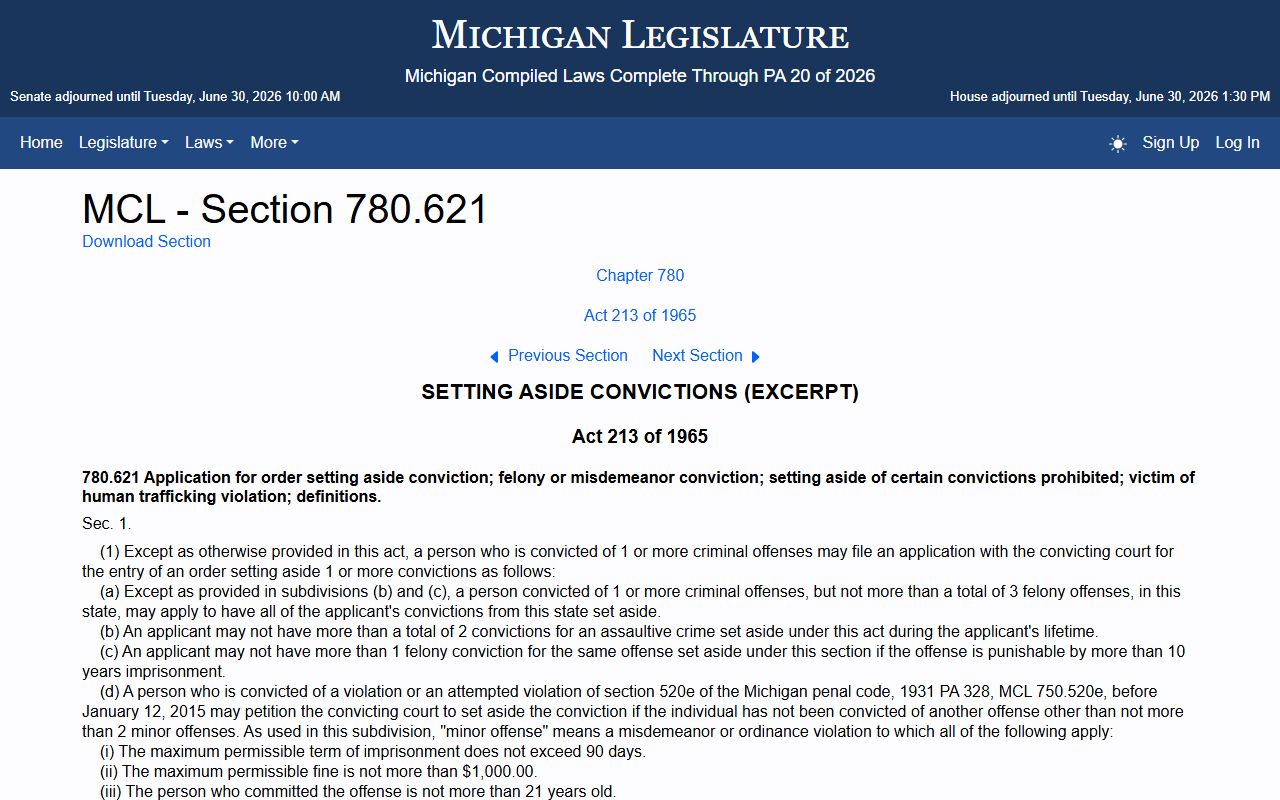
An eligible person files in the court of conviction, notifies the prosecutor, and attends a hearing before an order can issue.
| Sealed | Expunged | |
|---|---|---|
| Visibility | Hidden from public | Set aside and removed from public search |
| Law Enforcement | Limited access | Very limited access |
| Eligibility | Set-aside is Michigan's route; not automatic | Eligible after a waiting period under MCL 780.621 |
Public Access to Benzie County Criminal Court Records
Michigan treats court records as public unless a rule or statute says otherwise. Criminal case files are open, so a member of the public can view charges, pleas, and dispositions through the case search or at the clerk's office. When a document is not posted online, the next step is a records request to the court clerk or the county. The county FOIA office takes requests at 231-882-0558 and FOIA@benzieco.gov, based at 448 Court Place in Beulah. Responses commonly arrive within five business days, and a deposit may apply when the estimate runs high.
Key Statutes:
Michigan MCL 15.231 - the Freedom of Information Act, which makes public records open unless an exemption applies.
Michigan MCL 15.243 - lists the categories a public body may withhold or redact from a record.
Certified copies carry the clerk's seal and are needed for legal use. The county charges ten dollars for the first page of a certified court record and one dollar for each added page, while plain copies are billed by the sheet. Older files that were never digitized do not appear in the online search, so those still take a phone call or a written request to the clerk. Michigan court rule MCR 8.119 also limits how much of a document image a court posts to the internet, which is why some files are viewable only at the counter.
Background Check Considerations
A casual case lookup is not the same as a formal background check. For a statewide criminal history, the Michigan State Police runs a search that pulls felony and serious misdemeanor records from across the state. Employers and landlords who screen applicants must follow federal and state rules that a quick public search does not meet. The image below shows the Michigan State Police criminal history page.
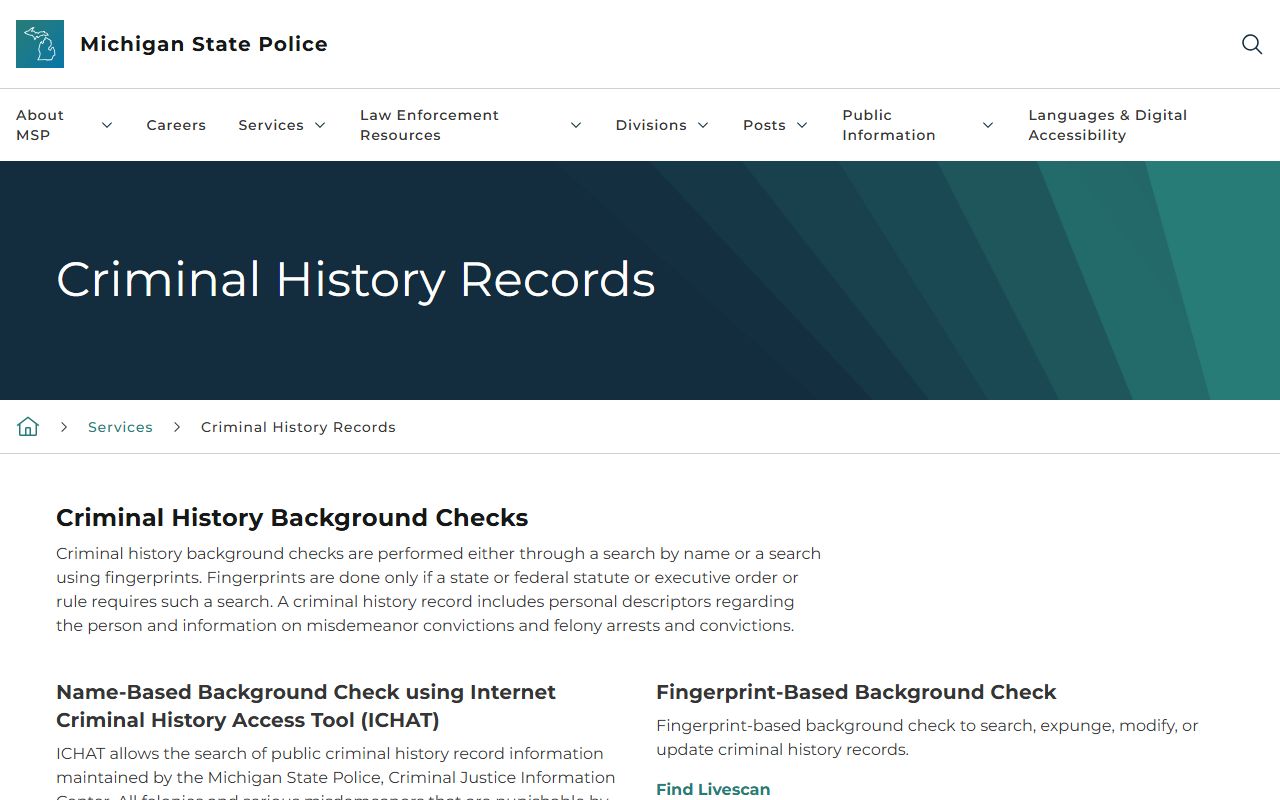
That service, known as ICHAT, is the state's official way to check a person's criminal history for a fee.
Important: A public case search is not a certified background check. Credit, employment, tenant, and insurance decisions call for a formal Michigan criminal history check through the state, not an informal court records lookup.
Restricted Criminal Court Records in Benzie County
Not every criminal court record is open. Juvenile delinquency files are restricted under MCL 712A.28, which limits who may see a young person's case. Sealed and set-aside matters drop out of public search once an order is entered. Records tied to an open investigation may be withheld until a charge is filed. Personal data such as Social Security numbers is redacted from public files. The image below shows the state's criminal history set-aside statute, MCL 780.621c.
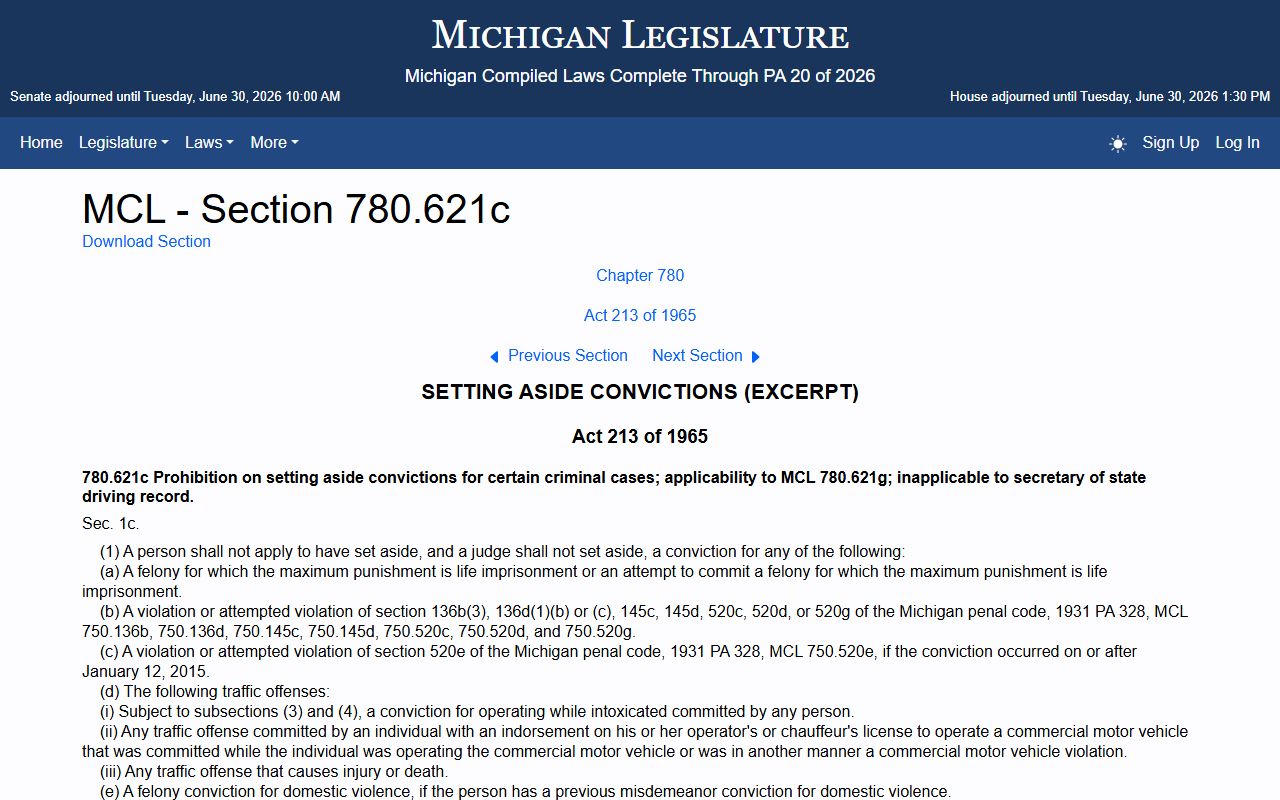
That statute governs how a set-aside conviction is treated once the court grants relief. For records that a public search will not show, the county FOIA process and the circuit court clerk remain the correct channels.